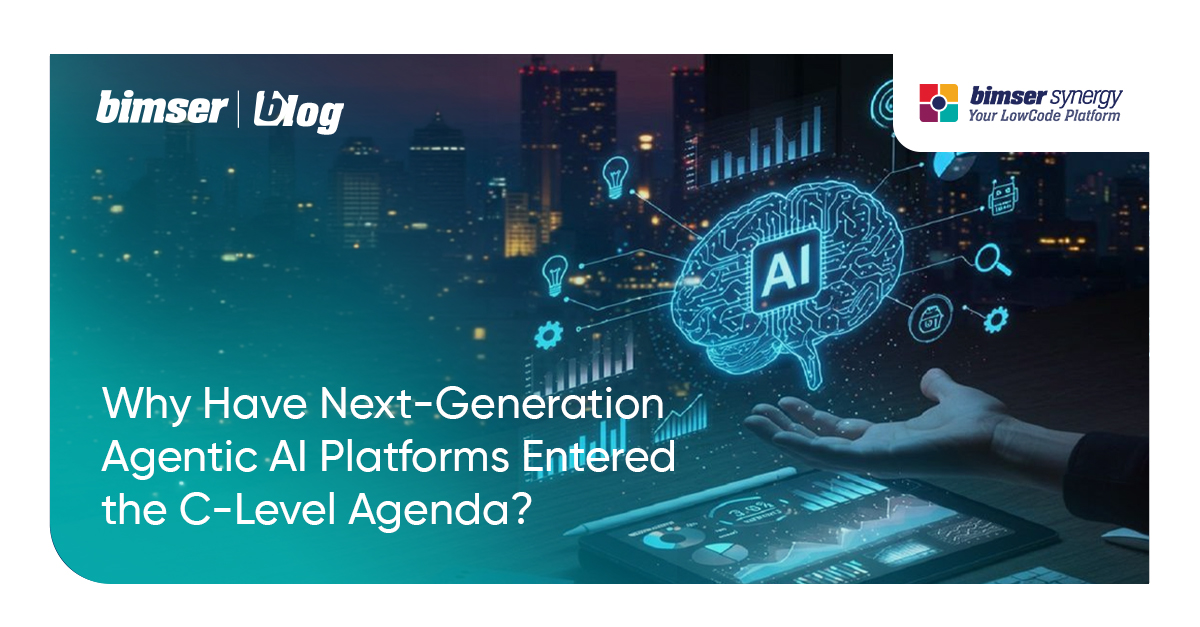
Why Have Next-Generation Agentic AI Platforms Entered the C-Level Agenda?
Digital transformation isn’t just a concern of IT departments anymore. It is at the center of the strategic agenda of all C-level executives from CEO to CFO, COO to CIO. Increasing competition, regulatory pressure, operational costs, and the expectation for speed make organizations turn to more agile, scalable, and sustainable technological infrastructures. At this point, next-gen Agentic AI platforms are not only automation tools. They are autonomous accelerators of organizational structure.
Transformation From The First Wave of Low-Code to Agentic AI Platforms
When the low-code concept first emerged, the main purpose was to accelerate software development processes and decrease the need for technical knowledge. However, first-wave platforms generally had limited capacity for deep decision-making. They were struggling with complex integrations and failing to satisfy the autonomy required by modern enterprise scale.
On the other hand, next-gen Agentic AI platforms exceed these limitations. They offer solutions that are compatible with enterprise architecture, microservice-supported, built on an API-first approach, and equipped with autonomous agents capable of independent reasoning. This transformation has turned technology from a “fast solution production tool” into an “autonomous component of corporate technology strategy.”
According to analyst reports, the rapid growth of the Agentic AI market and the increase in corporate investments show that this technology is the next frontier of productivity. Especially in sectors where operational efficiency directly affects competitive advantage, Agentic AI is not just a choice but a strategic necessity. These platforms are no longer just for building apps; they play the lead role in end-to-end autonomous process execution. Gartner predictions suggest that the majority of organizational interactions will soon be managed by autonomous agents, indicating that Agentic AI is the new mainstream development and execution approach.
Asynchronous Architecture and Its Effect on Business Continuity
One of the most significant reasons next-gen Agentic AI platforms appear on the C-level agenda is their support for asynchronous architecture. In an Agentic environment, an asynchronous structure is vital because it allows AI agents to work independently from one another. A delay in one agent’s data processing or a temporary interruption in an external service doesn’t stop the entire organizational workflow.
This approach is critical especially for organizations processing high-volume data and running many complex processes simultaneously. In sectors like finance and manufacturing, where uninterrupted operation is non-negotiable, business continuity directly affects brand reputation.
With asynchronous Agentic architecture:
- System performance is optimized as agents work in the background without blocking user interfaces.
- Scaling is performed in a more controlled way, allowing more agents to be deployed as data volume grows.
- The risk of system crashes during unexpected peaks decreases, as tasks are queued and handled autonomously.
For C-level executives, this means the minimization of operational risks and the protection of SLA (Service Level Agreement) objectives. Bimser Synergy AI’s architectural approach supports this by offering a central but flexible integration layer that ensures business continuity through autonomous task management.
The Importance of Web-Based Management for Organizational Agility
Web-based development and management offer the advantages of location-independent access. Today, with widespread hybrid work, the ability to supervise and coordinate AI agents through a browser has become a strategic necessity.
Organizational agility is the capacity to quickly respond to changing market conditions. With web-based Agentic AI platforms:
- New autonomous agents can be quickly modeled and deployed.
- Agent logic can be updated centrally across the entire organization.
- Version management of AI models becomes more effective.
This structure strengthens cooperation between IT and business units. Business leaders can supervise “Agentic workflows” under IT governance, reducing software development bottlenecks. For the C-level, this means increased innovation speed and a significantly shorter time-to-market for new services.
Strategic Value of Integration and Scalability
Within organizational structures, systems such as ERP, CRM, and HR must work together. Next-gen Agentic AI platforms’ strong API and integration abilities allow autonomous agents to communicate across these systems without interruption.
A platform with low integration ability may offer short-term fixes but leads to “technological islands.” This results in data silos and slows down the autonomous agents’ ability to make informed decisions. On the other hand, a scalable and integrated structure:
- Ensures data consistency for AI training and execution.
- Increases reporting and real-time analytics capacity.
- Provides an infrastructure aligned with aggressive organizational growth objectives.
For the CFO, this means optimized total cost of ownership (TCO). For the CIO, it means decreasing technical debt by building a sustainable, agent-ready architecture. Bimser Synergy AI’s integration capability allows organizations to start their autonomous transformation without changing their existing infrastructure, decreasing investment risk.
What the Agentic AI Approach Means for Upper Management
The transition from standard automation to Agentic AI represents the second phase of digital transformation. While standard tools follow a set of “if-then” rules, Agentic AI agents can observe a process, identify bottlenecks, fill smart forms, perform predictive analysis, and take corrective actions autonomously.
For upper management, an Agentic AI-supported approach means:
- Autonomous Decision-Making: Agents handle routine approvals and data validation, accelerating the speed of business.
- Minimal Human Error: By automating complex data transfers between systems, the risk of manual error is eliminated.
- Operational Speed: Decision-making cycles that used to take days can now happen in seconds.
Reports show that Agentic AI integration directly affects an organization’s competitive power. Bimser Synergy AI makes process data centrally accessible, providing the necessary “brain” for these autonomous agents to act as a strategic investment for the firm.
How to Choose a Future-Ready Agentic Platform?
C-level managers should prioritize the following criteria during their strategic evaluation:
- Architectural Flexibility: Support for microservices and asynchronous structures to host multiple AI agents.
- Security and Compliance: Full compatibility with local regulations (like KVKK) and global data standards.
- Autonomous Scalability: The ability to handle increasing process complexity and data volume without manual intervention.
- Integration Readiness: An API-first approach that allows agents to interact with every part of the existing tech stack.
At this point, Bimser Synergy AI stands out with its next-gen Agentic approach. It accompanies organizations in their strategic transformation journey by offering scalable, integrated, and autonomous solutions in business process and document management. It provides the perfect balance between global technology trends and local compliance needs.
Bimser Synergy AI isn’t just a technical tool; it is the strategic transformation partner that will lead your organization into the era of autonomous business.
Try Bimser Synergy AI now to experience how autonomous agents can fit your business processes, work in integration with your existing systems, and drive your operational efficiency to unprecedented levels. Contact us today to schedule a customized Agentic AI demo for your organization.